
Choosing a diamond and designing your engagement ring can be overwhelming and confusing! Below is a guide we put together to hopefully make the design process easier to navigate.
Education
The 4C’s
were invented by the GIA (Gemological Institute of America) in the 1940s. They serve as a universal framework for assessing a diamond’s characteristics. Variations of all 4 of these shapes can significantly influence the price of the stone.
-
Cut refers to how well the diamond’s facets reflect and interact with light. It is the ability the stone can transmit sparkle!
The cut scale includes: Fair, Good, Very Good, Ideal, Super Ideal
On a diamond grading report, the Cut is only graded for round brilliant stones. Because of this, buyers should not rely solely on the report when buying fancy cut stones.
-
Clarity refers to any internal or external inclusions or blemishes. The clarity grade is determined by how noticable these imperfections are under 10x magnification.
The clarity grade scale includes: Included (I1, I2, I3), Slightly Included (SI1, SI2), Very Slightly Included (VS1, VS2), Very Very Slightly Included (VVS1, VVS2), Internally Flawless (IF), Flawless (F)
We avoid any I or SI stones.
TIP: Prioritizing clarity when selecting your diamond really depends on the shape and cut of the diamond! For example, a crushed ice cut stone will hide any noticeable inclusions much better than an emerald shape stone.
TIP: You might not need to exclude the lower clarity grades when selecting your diamond because it really depends on where the inclusions are located. Some can be on the sides of the stone and some can be in the center!
-
Color refers to the lack of color within the stone. It is graded on a scale from D-Z.
Colorless: D, E, F
Near Colorless: G, H, I, J
Faint Color: K, L, M
Very Light Color: N-Z
TIP: Determining when to prioritize color can depend on the size/shape/cut of the stone or what metal you choose. A larger stone can bring out the color a bit more, making any faint color more obvious. Same with shape and cut - a step cut stone may show any faint color more vividly than a crushed ice cut stone. For metal color, a yellow gold setting/prongs can bring out warmth in the stone’s color versus if the setting was platinum or white gold.
It is all personal preference!
-
Carat refers to the diamond’s weight.
TIP: Prioritizing carat differs by shape and cut as well! Two different shaped stones with the same exact carat weight can look very different in size. For example, marquise cuts hold a lot of their weight on top, facing up a lot bigger than their carat weight compared to other shapes.
TIP: Don’t get too caught up in the carat size as a number. To the naked eye, the difference between a 1.9 ct stone and a 2.1 ct stone is not noticeable, however the price difference can be substantial.
Anatomy of a Diamond
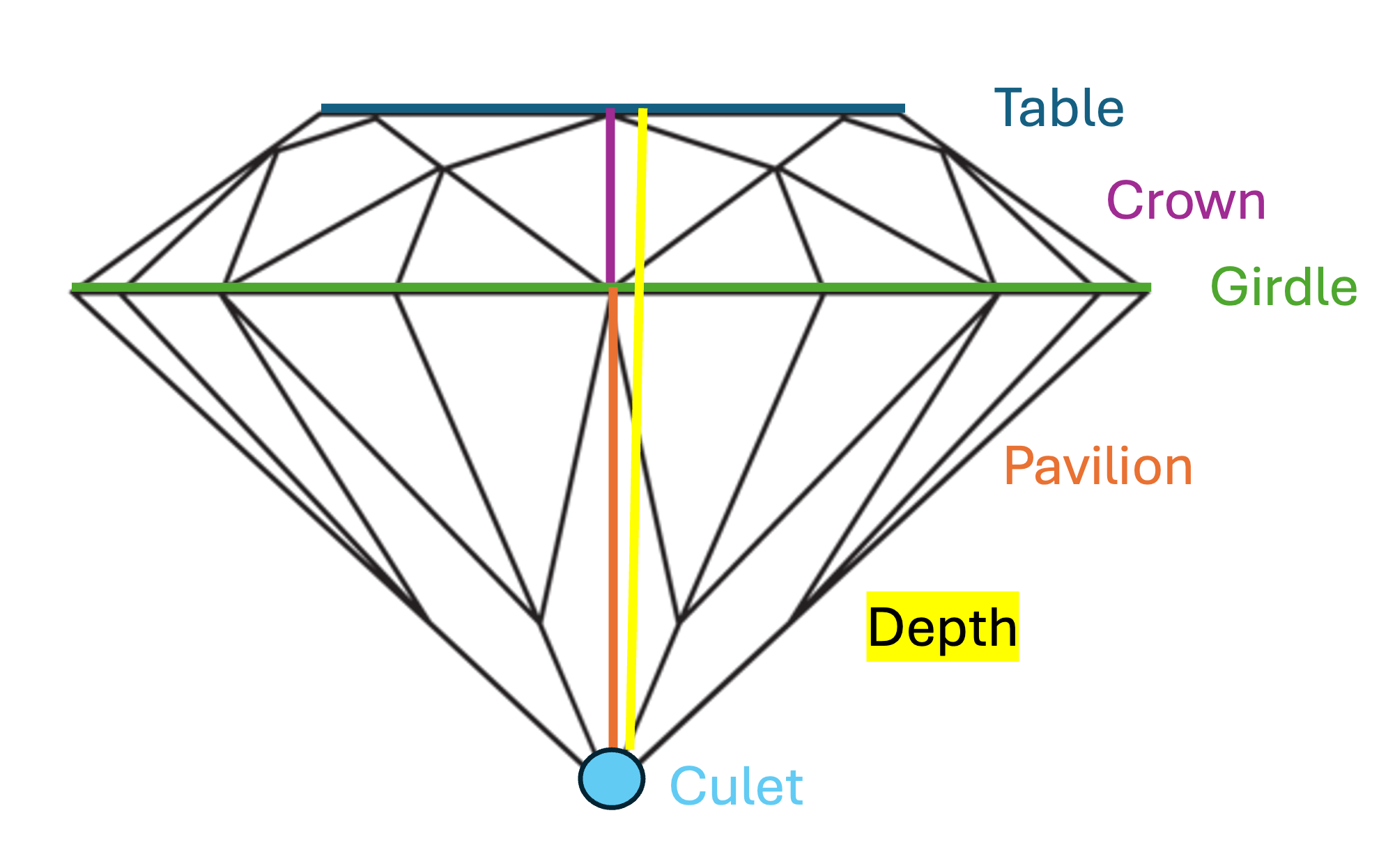
Metals
The difference between 14k and 18k gold is how much pure gold it is composed of. 14k gold is made up of 58.3% of pure gold, while 18k is 75%. The rest of the composition are metal alloys like silver, copper, zinc, and palladium. These alloys can influence the metal’s durability and color. Gold is a very malleable metal, so the higher percentage of gold, the more susceptible to warping. Gold is also very yellow, so the higher percentage of gold also translates to how yellow the metal appears.
White gold is an alloy of gold mixed with other metals like nickel, palladium, platinum, or manganese. When created into jewelry, it is often plated with rhodium to give it that crispy white color. Overtime, that rhodium plating can wear off (this is normal), and the jewelry will need a fresh plating. Please reach out for a rhodium refresh!
Rose gold is also an alloy of gold, just with more copper mixed in to give it that rosy color.
Platinum is its own pure element! It is a silver-colored metal and much rarer than gold, therefore much more expensive. The reason why some may choose platinum over white gold is because it is more durable than gold and is less prone to scratching or breaking. It also naturally has a crisp white color and doesn’t require maintenance over time like white gold.
Solid Gold vs Gold Filled vs Gold Plated
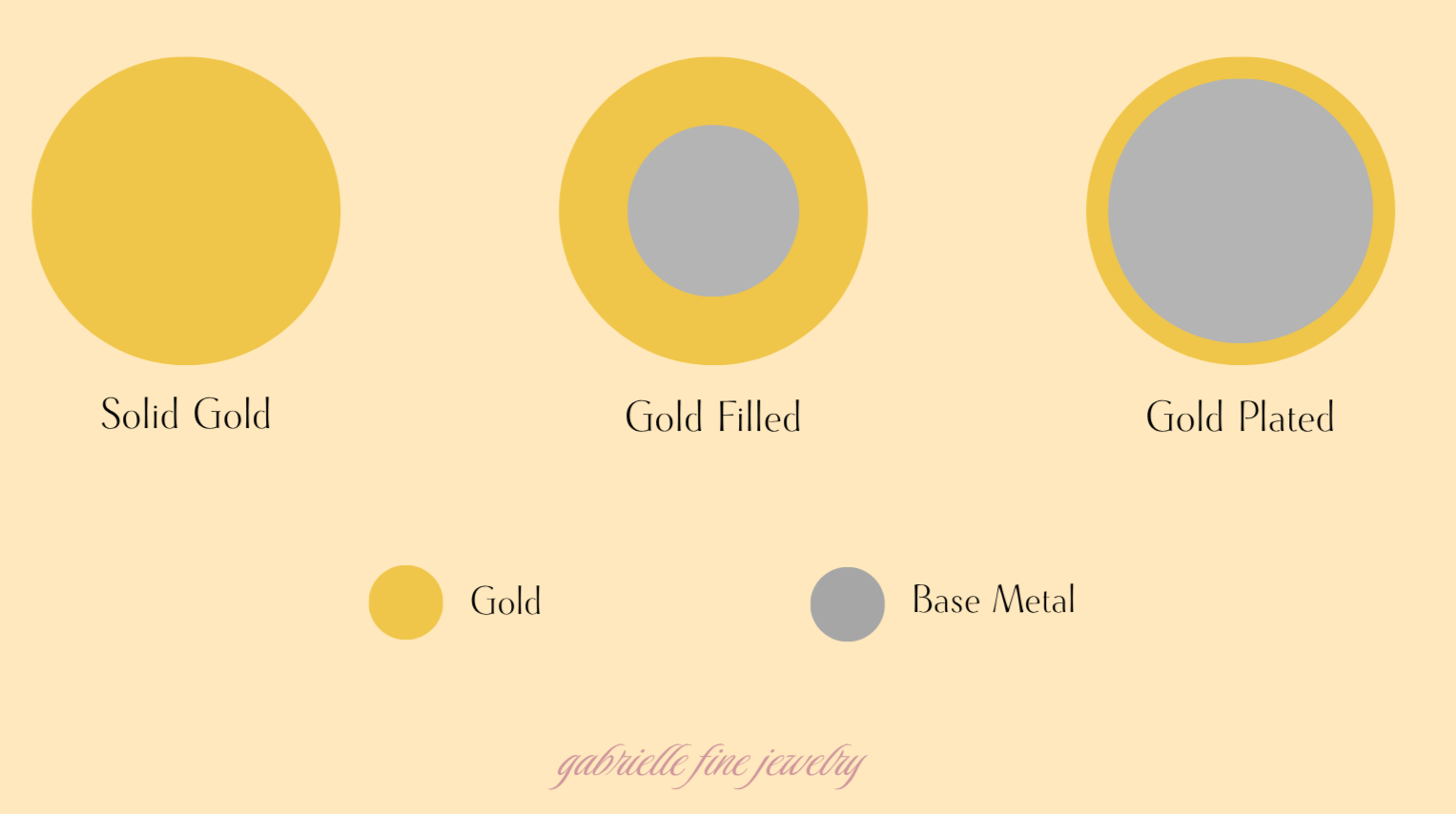
Solid Gold are the metals described above which is mainly what GFJ specializes in. Even though 14k and 18k gold have metal alloys mixed in, they are not considered gold-filled.
Gold Filled consists of 5% solid gold that is mechanically bonded to its base metal (usually brass).
Gold Plated usually has less than 0.05% of solid gold that is electroplated onto the base metal.
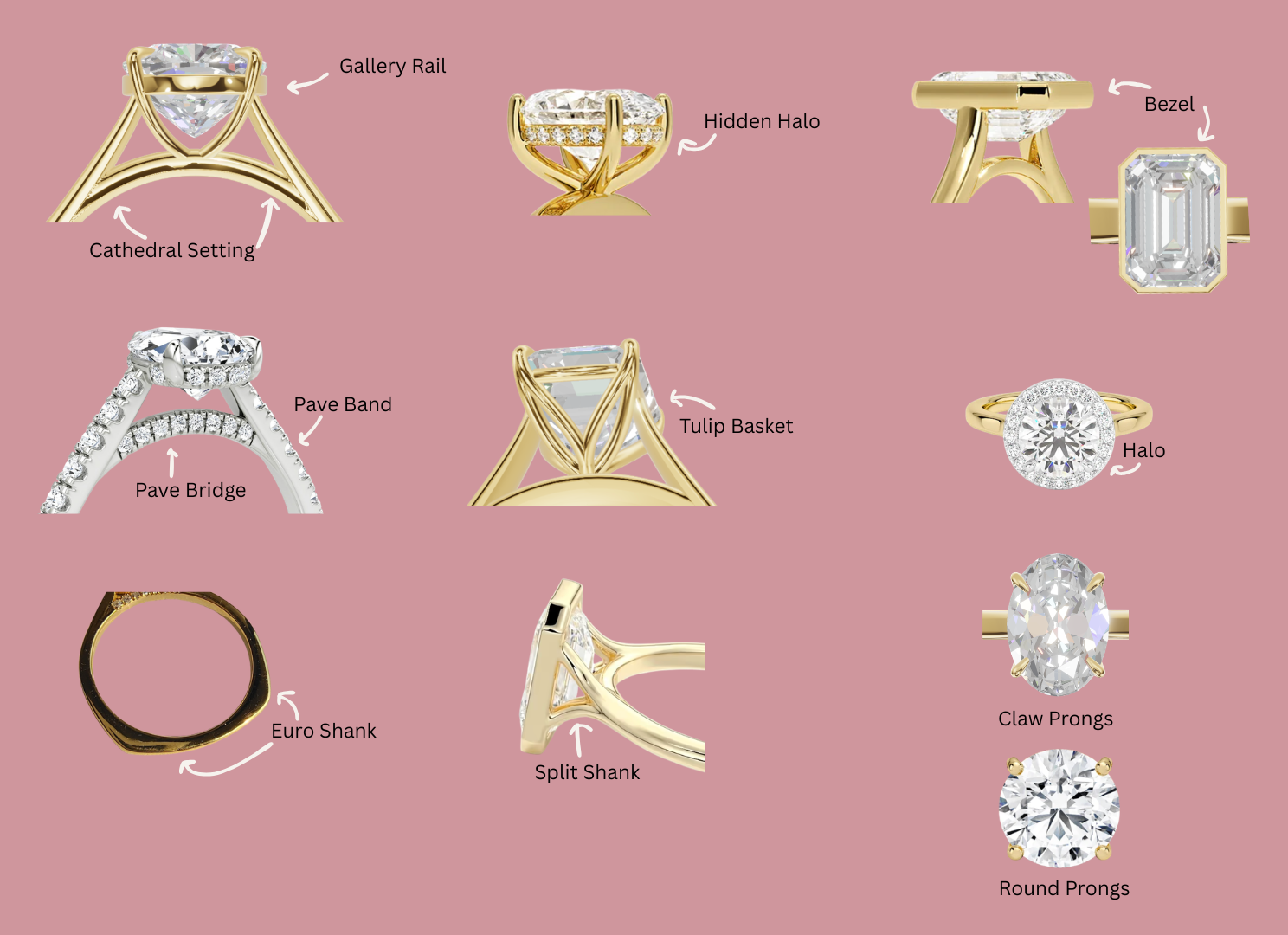
Styles, Settings, and Other Terms
Tips:
A gallery rail is highly encouraged! It adds much more stability for your stone, especially 2ct+ stones.
Pave adds fragility because stones often fall out from normal wear and tear no matter how well they are set.
A full pave band cannot be resized.
Euro shanks are extra metal added to the bottom of the band. It prevents your ring from spinning on your finger.
A bezel will be the most sturdy setting for your diamond.